

When most people think about school safety, they picture security cameras at entrances or a buzzer system at the front door. But for the IT directors and administrators running large K-12 districts, real safety and operational reliability starts much deeper — in the switches, the fiber lines, the wireless access points, and the intercom systems that connect every classroom, office, and building on campus.
The reality in many Rockland County schools is that the communication infrastructure hasn’t kept pace with everything else. Buildings have been renovated, curricula have changed, and student devices are everywhere — but the underlying phone, wireless, and intercom systems are often the same ones installed 20 years ago. That’s starting to change, and Top Line Communications has been part of that work throughout the region. Rockland’s Municipalities’ modernization of communication infrastructure is very similar to helping schools with many of the same requirements.
The Challenge: Aging Infrastructure in a Modern Compliance Environment
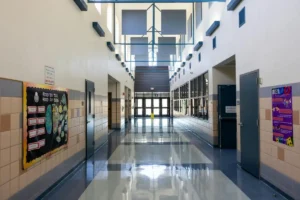
Rockland County School Districts Upgrade Communication System
New York State has added a lot to the plate of school IT departments over the past several years — updated requirements around emergency notification, network security, data privacy, and communication accessibility. None of it is unreasonable, but meeting those standards costs money, takes planning, and often means confronting infrastructure that was never built for any of this.
Walk through the typical Rockland County school building and you’ll still find copper phone lines, wireless access points that lose signal in the gym, and intercom systems that predate smartphones. They worked fine for what schools needed in 2005. They don’t work fine now.
The other thing worth saying: you don’t have to tear everything out at once. A good assessment tells you where the real gaps are, what’s still serviceable, and what a realistic upgrade timeline looks like. Done right, a phased approach keeps the building running, doesn’t blow the budget in year one, and gets you to where you need to be.
What that infrastructure actually looks like when it’s done right:
Fiber & Ethernet Cabling
Everything else depends on this. When the physical cabling is undersized or degraded, wireless drops, VoIP calls break up, and classroom displays lag at exactly the wrong moment. Properly installed fiber handles the simultaneous load of student devices, video conferencing, cloud platforms, and administrative networks — without the bottlenecks that older copper runs create.
Campus-Wide Wireless Solutions
Today’s classrooms depend on reliable Wi-Fi for Chromebooks, smart displays, student devices, and staff communications. A properly designed wireless network — with strategically placed access points and managed interference — ensures consistent coverage across every building, including gymnasiums, portable classrooms, and outdoor spaces.
Managed Switches and Network Infrastructure
The switches that route traffic across a school’s network are the unsung heroes of reliable communication. Modern managed switches allow IT teams to segment networks (keeping student traffic separate from administrative or security systems), prioritize critical applications, and identify problems before they become outages.
Audio-Visual Solutions Designed for Education
From projection systems and interactive displays to classroom audio amplification and PA integration, AV infrastructure has become a core part of how schools deliver instruction and communicate with students and staff. Systems designed specifically for education — rather than cobbled together from commercial products — make a measurable difference in how classrooms function.
Intercom and Emergency Notification Systems
School intercoms aren’t just a convenience — they’re part of how a building responds in an emergency. When something happens, staff need to reach every room at once, the main office needs to communicate with individual classrooms, and the system needs to work with whatever external emergency services are on the way. An intercom that glitches during a drill is a problem. One that fails during an actual incident is a serious liability. A lot of the systems still in use in older school buildings weren’t installed with any of that in mind.
What One Rockland County District Has Experienced Firsthand
Clarkstown Central School District, one of the largest and most respected districts in Rockland County, has been a Top Line Communications partner for close to two decades. Over that time, Top Line has supported the district’s evolving communication and technology infrastructure through multiple generations of upgrades, keeping systems current as both the technology and the compliance landscape have changed.
Richard Hernandez, the district’s Director of Information Technology, Network Operations, IT Services & Infrastructure, recently gave his opinion on that long-term relationship:
“For several years, our school district has partnered with Top Line Communications, with excellent results. Their wide range of services for us includes wireless solutions, switches, reliable data lines (ethernet, fiber), and audio-visual solutions specially crafted for education and classroom setups. Top Line Communications offers professionalism and impressive efficiency, delivering rapid turnaround times that improve our operational functions. We highly recommend their services to any organization in need of a dependable partner.”
— Richard Hernandez, Director of Information Technology — CCSD, New City, NY
Richard’s point about turnaround time is worth stopping on. In a school district, slow response isn’t just an inconvenience — a switch goes down and a wing of the building loses connectivity, a fiber line fails and the front office is scrambling, an AV system stops working an hour before a board meeting. These things happen, and when they do, who you can call and how fast they show up matters more than almost anything else in the vendor relationship.
The breadth of services Richard describes — wireless, switching, fiber, ethernet, and education-specific AV — also reflects something Top Line brings to every school engagement: the ability to handle the full communication stack, not just one piece of it. Districts don’t have to manage four different vendors with four different service schedules. One partner. One call. One relationship that deepens over time.
Why Long-Term Partnerships Matter in K-12
School districts are not like typical businesses. The stakes for getting things wrong are uniquely high — and budget pressure is constant. The ideal communications partner isn’t just a vendor; they’re an extension of the district’s IT team.
Over a nearly 20-year relationship, a partner like Top Line builds something that can’t be replicated by a new vendor with a lower bid: institutional knowledge. We know where the fiber runs in Building C. We know which switches are aging out next. We know what a typical school day looks like — and we plan our work around it.
That continuity also protects districts from compliance gaps. As NY State updates its expectations around network security, emergency communication, and data privacy infrastructure, a long-term partner can proactively flag what needs to change rather than waiting for an audit to surface a problem.
Is Your School District Ready for What’s Next?
The size of your district doesn’t change what you actually need — systems that work, meet current safety requirements, and have real support behind them when something breaks.
Top Line Communications has been serving school districts, municipalities, hospitals, and businesses across Westchester, Rockland, Putnam, and Orange Counties for more than 30 years. If your district is due for an infrastructure review — or if you’ve already identified gaps you need to address — we’d welcome the conversation.
Call us toll free: 1-866-95TOPLINE (845-621-3800)
 Helping make the Westchester Children’s Museum a reality
 SUCCESS STORIES: BRIDGING THE COMMUNICATION GAP