

If you’re still relying on metal keys to secure your office, you’re not alone — but you may be more vulnerable than you think. Across Westchester, Rockland, Putnam, Orange, and Fairfield counties, businesses are quietly upgrading to modern access control systems that do far more than just lock and unlock doors.
At Top Line Communications, we’ve been designing and installing access control systems for businesses throughout the region for over 30 years. And in that time, the technology has changed dramatically (especially in the last decade). Here’s what every business owner should know.
What Is Access Control, Exactly?
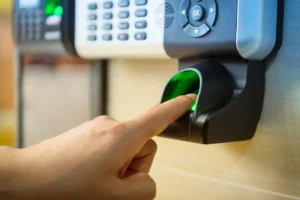
Control Access Security Systems for Westchester County Businesses
Access control is any system that manages who can enter — or exit — a space, and when. In its simplest form, that’s always been a lock and a key. But today’s electronic access control systems go well beyond that.
Modern systems use credentials like keycards, key fobs, PIN codes, and smartphone apps to grant or restrict entry to doors, floors, server rooms, loading docks, and more. And they do it with a level of visibility and control that a physical key simply can’t match.
According to the U.S. Chamber of Commerce, more than half of small businesses report some type of physical loss from shoplifting or break-ins — and many of those businesses didn’t have access controls in place when the incident occurred.
What’s Changed: From Keys to Cloud
Not long ago, access control meant a keypad at the front door and a logbook at the front desk. That’s changed significantly — and quickly. Here’s what the evolution looks like:
Traditional lock-and-key systems worked fine when businesses had a handful of employees and one or two entry points. The problem? When an employee left, you either hoped they returned the key or paid to rekey the locks. There was no record of who went where, and no way to restrict access to sensitive areas.
Card reader and key fob systems replaced physical keys for most commercial properties and became the standard through the 2000s and 2010s. A terminated employee’s card could be deactivated instantly — no locksmith needed. These systems also introduced basic audit trails, so you could see who badged in at what time.
Cloud-based and IP-networked systems are where access control is today. These platforms connect your access points across your entire facility — or across multiple locations — and manage everything through a centralized dashboard you can reach from anywhere. Grant access, revoke it, review logs, lock a door remotely: it all happens in real time from a browser or mobile app.
Mobile and biometric access is where things are heading next. Smartphone-based credentials let employees use their phone as a keycard. Biometric readers — fingerprint or facial recognition — eliminate credentials entirely. These are no longer science fiction; they’re increasingly standard in Westchester’s corporate, healthcare, and industrial environments.
Why This Matters for Your Business
You might be thinking: we’re a small office in White Plains, not a government facility — do we really need this? Here’s the honest answer: the size of your business doesn’t determine your risk. It determines the scale of the system you need.
The SBA and FTC both highlight physical access control as a fundamental layer of business security — not just a large-enterprise concern. Consider a few common scenarios we see regularly across the region:
An employee is terminated. With a traditional key system, you either trust they won’t return or you pay to rekey every lock they had access to. With an electronic system, their credential is revoked in seconds from a phone or computer — before they’ve even left the building.
A break-in or theft occurs. With a modern access control system, you have a complete audit trail. You know exactly which credential was used, at which door, and at what time. That’s valuable for your investigation — and for your insurance claim.
You have areas that require restricted access. Server rooms, pharmaceutical storage, financial records, executive offices — not everyone in your organization should have access to everything. Modern access control lets you define granular permissions by employee, role, time of day, or day of week.
You have multiple locations. Managing access across two, three, or more sites from a single platform is one of the most significant operational upgrades a growing business can make.
How Access Control Integrates with Your Other Systems
This is where Top Line Communications stands apart from a traditional locksmith or standalone security company. Access control doesn’t live in a silo — it works best as part of a fully integrated communications and security infrastructure.
When we design an access control system, we build it to work alongside:
- Video surveillance: Pair access control with your CCTV system and you can automatically pull the camera footage associated with any access event. A door forced open triggers an alert and pulls the clip. See our post: Why Every Business Needs a Modern Video Security System — the two systems are natural partners.
- Network cabling infrastructure: Cloud-based and IP-networked access control systems run on your data network. The quality of your cabling directly affects reliability. A solid structured cabling foundation is the backbone of every modern security system. Read more: How Quality Cabling Keeps Westchester Businesses Connected.
- Data network infrastructure: Access control systems are only as reliable as the network they run on. See how we approach network design for Westchester businesses: Data Network Installation in Westchester & Fairfield Counties.
- VoIP and intercom systems: Video intercoms at building entrances integrate with your phone system so staff can screen and admit visitors without leaving their desk. This is increasingly common in medical offices, professional services firms, and multi-tenant buildings across Westchester County. Learn about our phone systems: Business Phone Systems Westchester.
What to Expect from a Modern Installation
If it’s been a while since you’ve evaluated your access control setup — or if you’ve never had one — here’s what a professional installation process looks like with Top Line:
- Consultation and site assessment: We walk your facility, understand your workflow, and identify every access point that needs coverage. We also discuss who needs access to what, and when.
- System design: We recommend the right combination of hardware (readers, credentials, controllers) and software (cloud management platform) for your facility size, budget, and use case.
- Infrastructure review: We check your existing cabling and network to ensure your access control system will run reliably. If upgrades are needed, we handle them.
- Installation and configuration: Our technicians install the hardware and configure every credential, permission level, and access schedule.
- Training: We make sure you know how to add and remove users, pull reports, and manage the system day-to-day — without needing to call us for routine tasks.
- Ongoing service: We offer maintenance service contracts so your system stays updated and any issues are addressed quickly.
The Bottom Line
Access control technology has come a long way from the metal key and the logbook. Today’s systems give Westchester businesses real-time visibility, remote control, seamless integration with video and communications infrastructure, and the ability to respond instantly when something changes — an employee leaves, a door is forced, or a new location opens.
If your business is still relying on keys, or running an older card system that hasn’t been updated in years, now is a good time to take a look at what’s available.
Top Line Communications serves businesses throughout Westchester, Rockland, Putnam, Orange, and Fairfield counties. We’d be happy to walk your facility and help you understand what a modern access control system would look like for your specific needs. Request a free consultation today.
 Helping make the Westchester Children’s Museum a reality
 SUCCESS STORIES: BRIDGING THE COMMUNICATION GAP